Paddy Hartley
Material: Ceramics | Location: Northumberland
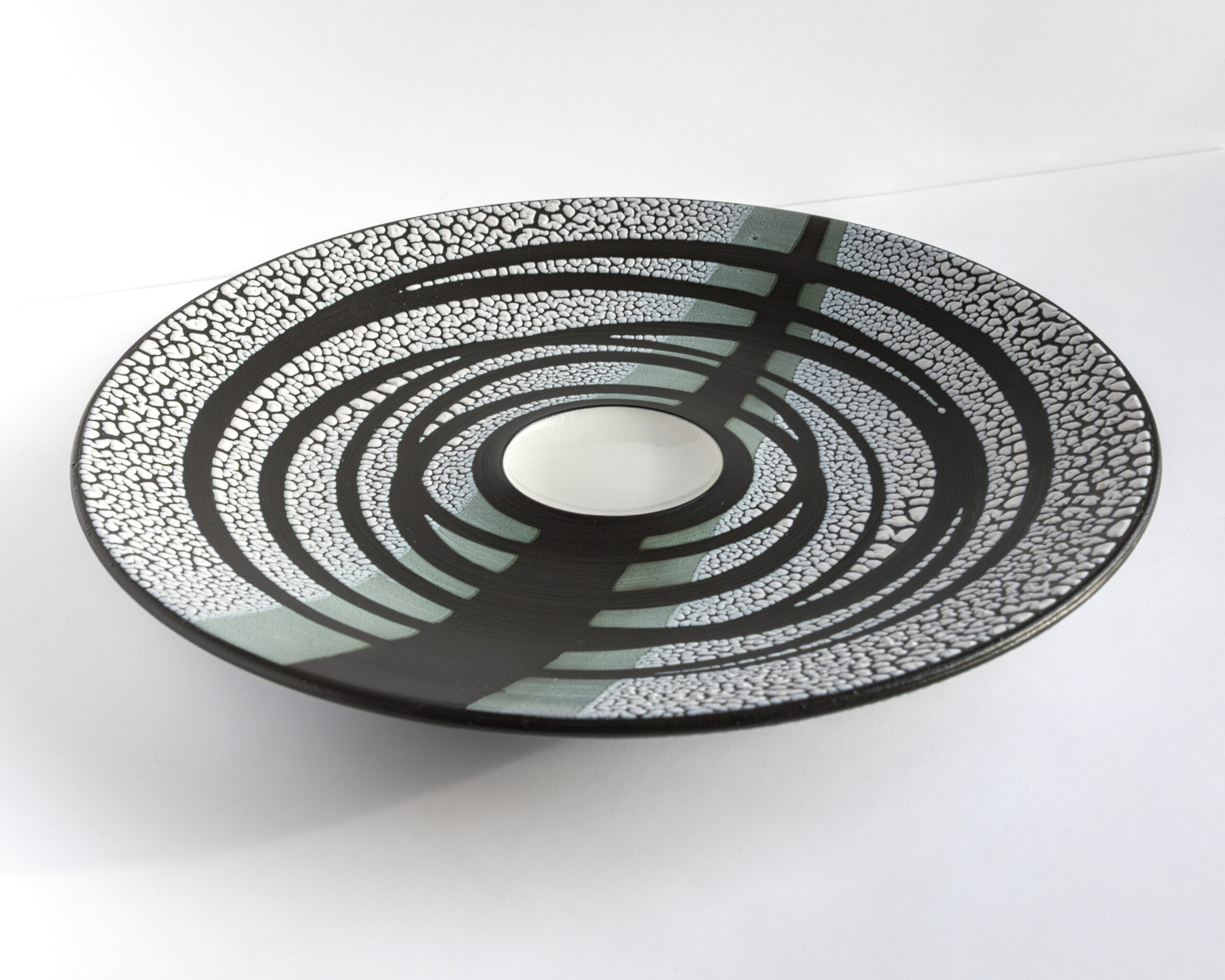
Paddy Hartley, a multidisciplinary artist based in Berwick-upon-Tweed, Northumberland, UK, has been creating art for over three decades. Paddy studied ceramics at the influential School of Ceramics, University of Wales Institute Cardiff (UWIC), from 1990 to 1993, under the tutelage of renowned potters Michael Casson, Geoffrey Swindell, and Alan Barrett-Danes. He returned to UWIC in 1997/98, achieving a first-class Master’s Degree in Ceramics.
Following 20 years in London, Paddy relocated his home and artistic practice to Berwick-upon-Tweed to undertake a major ceramic commission for the Swiss pharmaceutical company F. Hoffman la-Roche and upon completion, Paddy turned his attention to Northumberland’s natural environment for inspiration. This has had a significant influence on his work.
His new work, thrown stoneware forms, presented under the moniker ‘StudioShim’, draw their inspiration from the geology, man-made landmarks, and atmospheric conditions of the Northumbrian coastline. This marked a return to the origins of his love for ceramics, the versatility of clay and glaze, and its ability to reflect and interpret the landscape through a range of techniques and processes. It is showcased in a PDF catalogue (available on request) and outlined in this submission.
Throwing is the primary technique Paddy employs in the creation of his work, though some of the work is created using large hum/slump moulds. His thrown Monument and Column Vases, along with the Caldera collection, are created using thrown sections which are assembled and turned. His low crucible forms are thrown thick and heavy, and are turned on the wheel to reveal the desired form.
Paddy uses layered glaze combinations to achieve his unique signature palette, often bis firing a glaze to a piece to then reglaze and fire to temperature. The work will more often than not go through three to four firings in total.
Paddy’s work is intentionally created with heft, this being both an aesthetic decision but also one of practicality, providing stability to tall forms which are currently up to 50cm tall (and will be exceeding this height). The robustness of the work also means it ships easily, making it ideal for online sales.


